Don’t Plug In Old Electronics Before an Inspection

Will it turn on?
Digging out an old piece of gear can be exciting in many ways. More often than not, this results in the phrase “I wonder if it still works.” While tempting to say the least, resisting the urge to “Fire it up” can literally save you from “Fired it up.” This article is all about reasons to not plug in your old gear before an inspection.
First and simplest item on the list is the power cable. Most commonly old gear will have a crusty dried up cord, and when plugged into an outlet can cause a short circuit. Of course, we all know short circuits are bad. The damage can be worse depending on the environment like surroundings, circuit protection devices, and shock hazard. A thorough inspection will prevent these risks and results.
Vacuumless Tubes
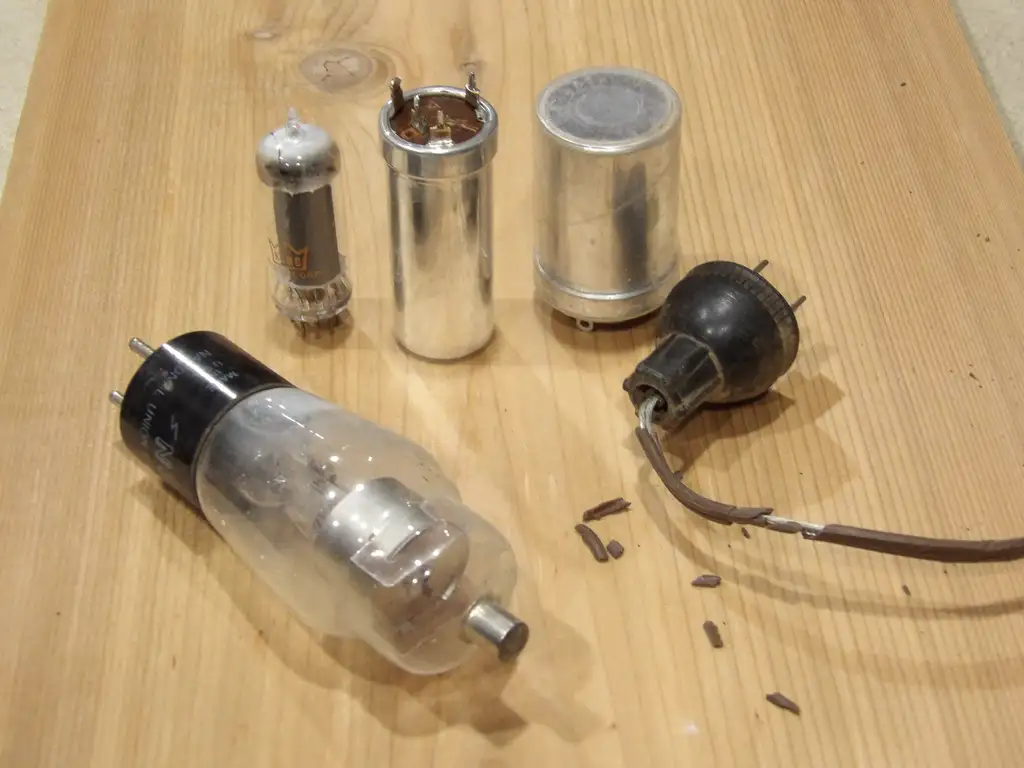
While tubes are actually very reliable, they can fail in a few ways. Most often tubes are made of glass, sometimes metal, made to keep a vacuum inside. This allows the tube to function without burning out. You may see a shiny silver spot inside and think it is bad; however, the shiny silver spot is an indicator of a good tube. After heavy use these spots will turn more of a brown color indicating it is wearing out.
The most important thing to know is you do not want to see a white spot as the picture above shows. This indicates the presence of air inside the tube rendering it useless. Under this condition, tubes will get extremely hot and cause the filament to draw heavy current compared to normal. Most commonly this is caused by physical damage like cracks or a sealing problem where the leads exit the glass. The number one killer of tubes are the surrounding components…
Aging Parts
Vacuum tube gear in this day and age is just that, well aged. Just like the tubes, all the surrounding components are probably equally as old. A prime example of such parts are capacitors. These devices are made to block direct current=DC and pass alternating current=AC. Over time capacitors can become “leaky” and pass DC. This causes problems in a lot of ways depending where they are in a circuit.
In coupling positions, leaky caps will change the bias on a tube, causing it to “turn on” at all times. In most cases, tubes are not made to handle continuous ON time. So when this condition is present, internal damage and surrounding component damage will occur. Audio output tubes biased in this way will commonly burn out the output transformer.
In power supply filtering positions, they are placed from the power “rail” to ground. This creates a smoothing effect to cancel out the pulses and provide clean power. Old caps of this style may still show some life and operate correctly. The tricky part is they can unexpectedly short with no warning. This puts heavy load on the rectifier and transformer. If the item is not fused (most are not), this will continue until something gives out. Most times a tube will burn out before a transformer, but anything is possible.
Prevention
Losing a transformer in a piece of old gear can render it trash. Special transformers can be impossible to replace or very difficult to reverse engineer in modern day. Certain tube types are getting difficult to find, not to mention prices. The best way to prevent this from happening is simple: don’t plug it, check it. This is why we offer free safety inspections which we can confidently provide a yes or no if an item is safe or needs attention. If the item is deemed unsafe, we can put together an estimate for repairs for those wanting to bring their piece back to life for years to come.
Have Vintage Gear That Needs Care?
Send the details and photos so we can review the condition, parts needs, and best next step.
Start Vintage Intake